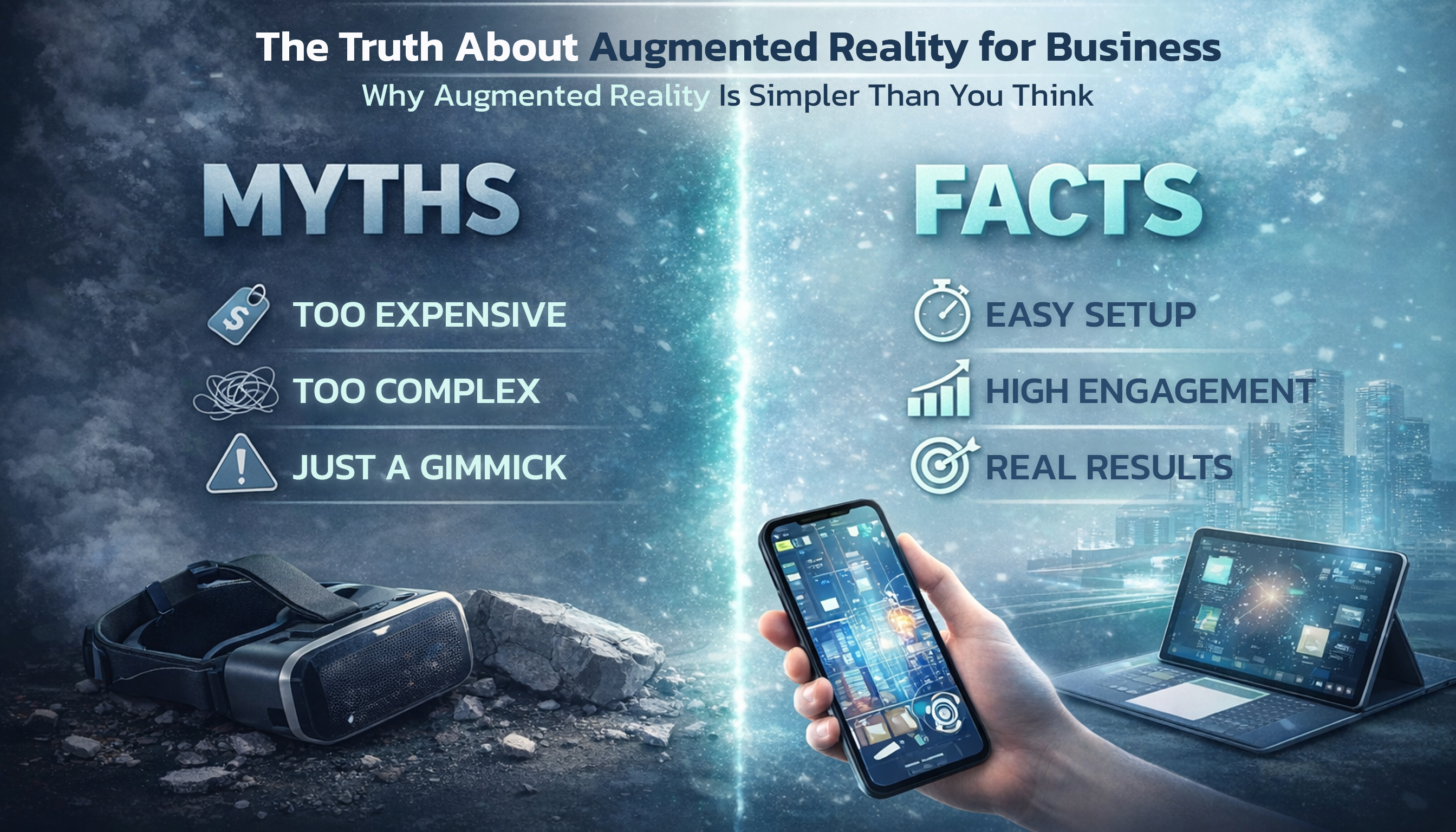
Augmented Reality (AR) is widely recognised as an exciting innovation, yet many business leaders hesitate to treat it as a practical tool. For founders, CEOs, CMOs, and marketing heads, AR often still feels expensive, complex, experimental, or something to explore later, not something to deploy today.
Industry research shows that the global augmented reality market is expanding rapidly. In 2024, the AR market was valued at around USD 83.65 billion and is expected to grow to approximately USD 140.34 billion in 2025, continuing toward nearly USD 600 billion by 2030.
Early AR solutions required heavy development effort, specialised technical teams, custom mobile applications, and long deployment cycles. These early limitations shaped long-lasting perceptions about AR complexity.
However, the AR ecosystem has evolved dramatically. Today, AR is no longer defined by technical friction. Modern WebAR solutions are app-free, browser-based, faster to deploy, and significantly more cost-efficient.
AR Adoption Across Industries: A Practical Shift
AR is no longer confined to innovation labs or global enterprises with experimental budgets. It is actively used across multiple industries to simplify communication and improve decision-making.
- Marketing & Branding: Interactive AR campaigns improve engagement and recall.
- Retail & E-commerce: Virtual try-ons and product previews reduce uncertainty before purchase.
- Real Estate: Immersive 3D walkthroughs and spatial visualisation without physical visits.
- Education & Training: Interactive overlays simplify learning and concept clarity.
- Manufacturing & Industrial: Assembly guidance, maintenance assistance, and process visualisation.
- Professional Services: Clear explanation of strategies, proposals, and ideas.
AR Myths vs Facts: What Businesses Get Wrong
Myth 1: AR is expensive and only for global brands
Reality: AR is now cost-efficient, scalable, and ROI-driven. Modern WebAR runs directly in mobile browsers, eliminating the need for apps and heavy development.
- Lower entry cost
- Faster go-to-market
- Clear cost-to-value visibility
Myth 2: AR needs a dedicated tech team
Reality: AR creation is now simple and marketer-friendly. Drag-and-drop WebAR platforms allow teams to create experiences without coding or specialised engineering.
Myth 3: AR takes too much time to deploy
Reality: AR experiences can now be created and deployed in minutes, not months. Experiences can be updated and optimised quickly.
Myth 4: AR is only for youngsters or Gen Z
Reality: AR is used across all age groups because it simplifies decision-making and improves clarity, not just entertainment.
Myth 5: AR is not relevant for my industry
Reality: AR applies across industries by improving how information is visualised and understood, regardless of business model.
Myth 6: AR is experimental and difficult to measure
Reality: Modern AR integrates with analytics to measure engagement, interaction depth, conversion influence, dwell time, and ROI.
Myth 7: The future of AR is uncertain
Reality: AR is on a strong global growth trajectory, supported by mobile-first adoption, practical use cases, and ecosystem maturity.
Modern AR Solutions Offer
- App-free, browser-based WebAR
- Low-cost, ROI-driven deployment
- Fast creation and launch cycles
- Seamless campaign integration
- Scalable experiences across industries
Conclusion: AR as a Strategic Business Enabler
The biggest myth about AR is that it requires a leap of faith. In reality, AR is a measurable, low-friction tool that helps businesses communicate value more clearly and make better decisions.
Curious to see how AR could work for your business? Explore real-world use cases or book a free demo with Immarsify.
Visit https://www.immarsify.com/